
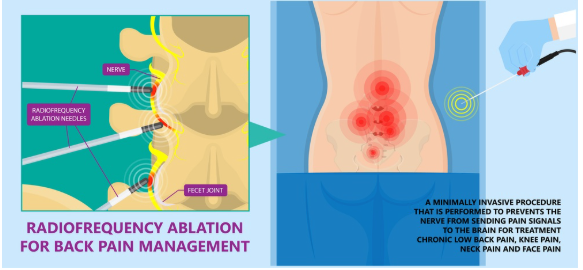
Chronic back or neck pain sufferers who speak of a radical medical treatment offering months or years of relief may be referring to radiofrequency ablation (RFA). Anything offering significant pain relief for a long time is attractive. Yet medical jargon can leave people wondering what actually happens during an ablation procedure.
If you have been wondering what the ‘ablation’ portion of RFA is all about, this post will answer your questions. By the time you are done reading, you should understand where the word comes from and how the process safely turns off the pain signals that bother you every day.
What Does ‘Ablation’ Actually Mean?
Tracing the word ‘ablation’ back to its Latin roots reveals an interesting meaning: ‘carrying away’. It is a term that medical science uses to describe removing or destroying tissue. As bad as that might sound, it is actually a good thing in the case of radiofrequency ablation.
Ablation techniques are utilized across various specialties within Western medicine. They are applied to removing abnormal heart pathways that cause arrhythmia. They are also part of the tumor destruction process in cancer treatments. For treating back pain, ablation is an interventional pain management procedure. Radiofrequency energy is applied to a targeted nerve in order to create a small lesion – which is essentially tissue destruction – that blocks pain signals.
How the Ablation Process Works in RFA
Understanding how RFA works is easier if you picture a sensory nerve as a fiber optic cable that constantly transmits signals to the brain. RFA safely stops traffic along the cable’s path without requiring invasive surgery. Here is a step-by-step description of how it works:
- A Nerve Is Targeted – The first step involves targeting a nerve. Using fluoroscopy, a doctor inserts a specialized needle that is guided precisely to the small sensory nerve transmitting the pain signals.
- Energy Is Delivered – The needle is also an electrode capable of producing high-frequency radio waves. The energy from these waves generates heat by way of localized friction at the needle’s tip.
- A Lesion Is Created – The heat creates a tiny, controlled lesion on a very small segment of the nerve tissue. The lesion effectively deactivates the nerve’s signaling mechanism without damaging any surrounding muscle tissue or major motor nerves.
Because pain signals never make it past the lesion, they never reach the brain. A patient feels limited or has no pain as long as the lesion remains. In most cases, nerve tissue will repair itself, meaning some patients have to undergo procedures every 6 to 18 months.
RFA vs. Radiofrequency Neurotomy
When researching RFA, it is common to come across a procedure known as radiofrequency neurotomy. But guess what? The two procedures are exactly the same. Radiofrequency neurotomy is the term preferred by Weatherford, Texas-based Lone Star Pain Medicine, but their procedure does not differ from a typical RFA procedure.
So why the different terms? It just depends on what a provider wants to emphasize:
- Radiofrequency Ablation – RFA emphasizes the mechanism of the procedure. It describes the idea of radiofrequency energy ablating nerve tissue.
- Radiofrequency Neurotomy – RFN emphasizes the outcome of the procedure. Neurotomy is a term based on Greek roots that describes disrupting the nerve pathway.
Whether your provider refers to RFA or radiofrequency neurotomy, the process, goals, and results are the same. And for many people living with chronic neck or back pain, RFA is the only treatment that offers real and long-lasting pain relief.
Despite the medical jargon surrounding RFA, it is a safe and effective treatment. Ask your doctor about it if more conventional treatments have failed to relieve your chronic pain.